publications
selected and recent publications. For the full and most up-to-date list, please see Google Scholar.
2026
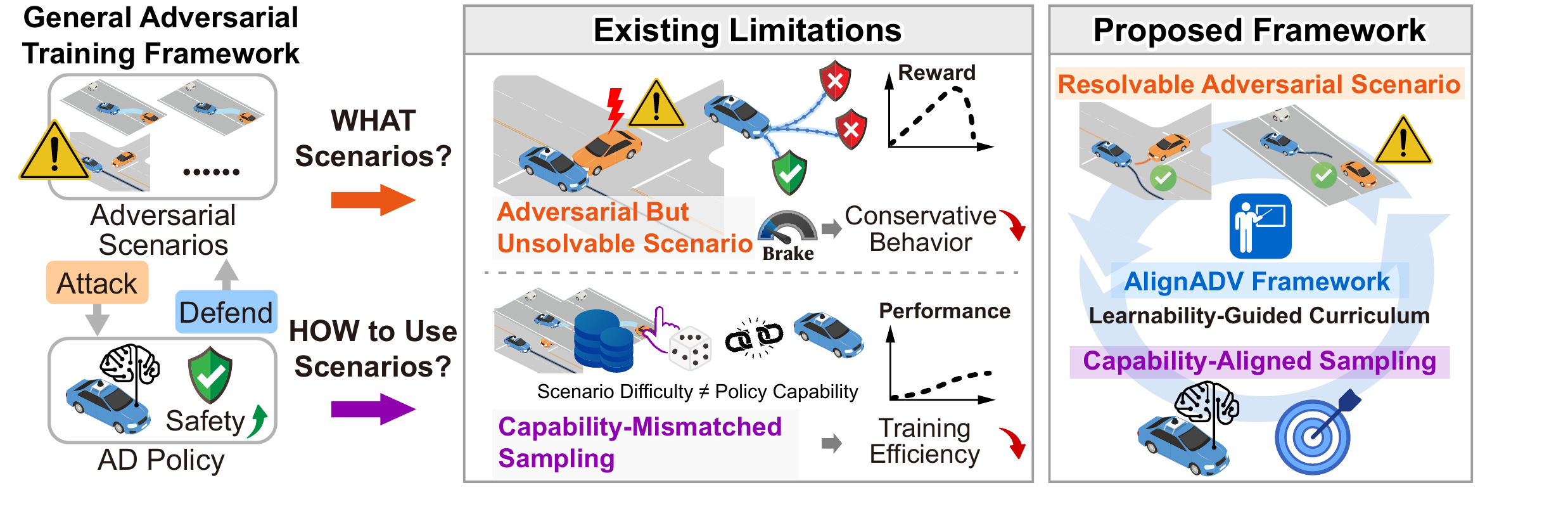
- From Attacks to Curricula: Learnability-Guided Adversarial Training for Safe Autonomous DrivingarXiv preprint arXiv:2606.14032, 2026TL;DR: Turns adversarial attacks into learnability-guided curricula so autonomous driving policies train on hard but useful scenarios for safer closed-loop robustness.
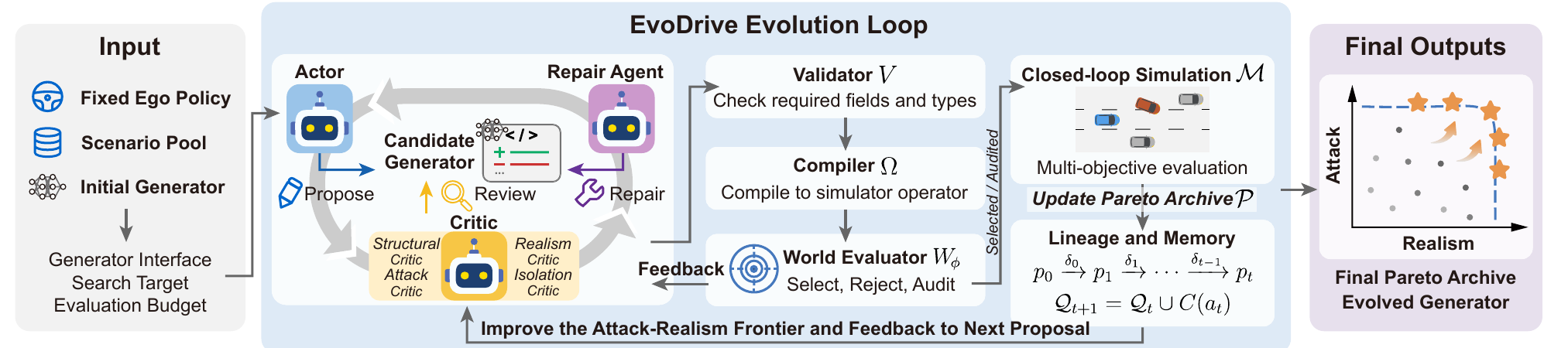
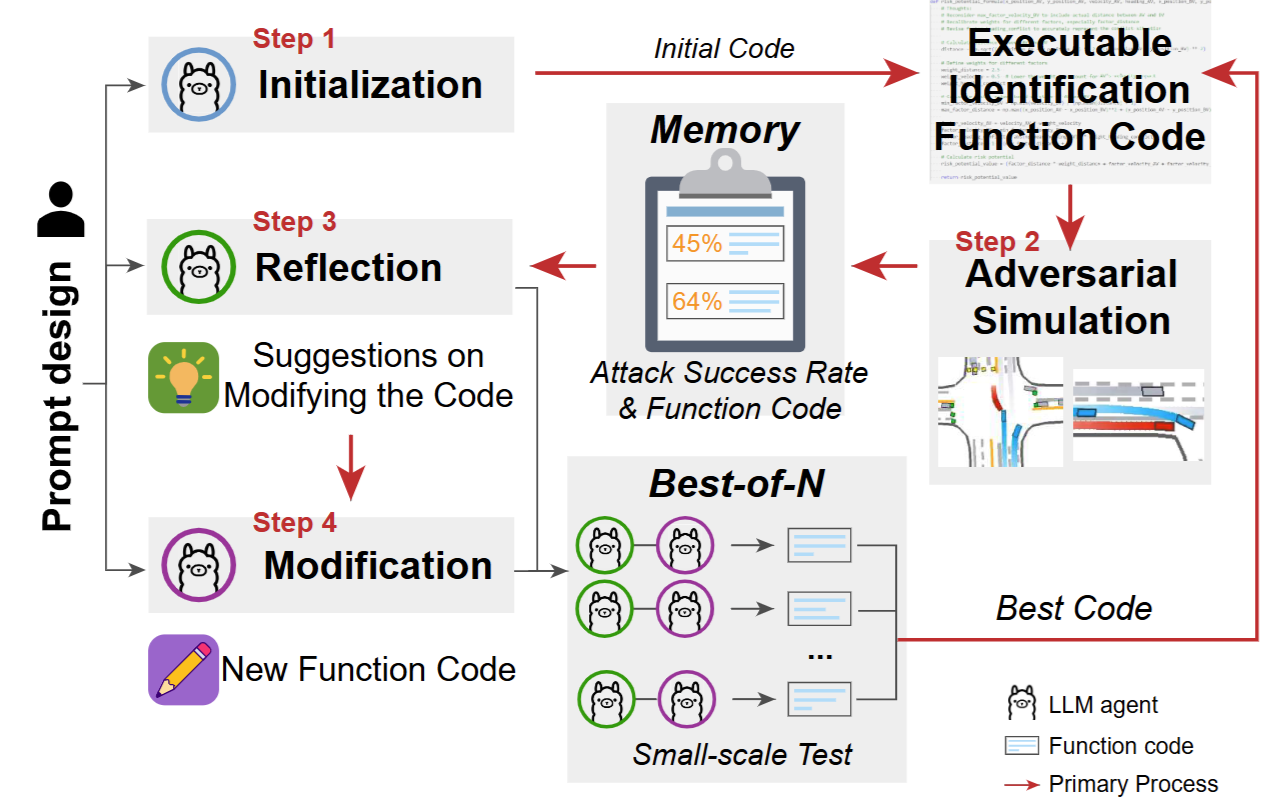
- EvoDrive: Pareto Evolution for Safety-Critical Autonomous Driving via Self-Improving LLM AgentsarXiv preprint arXiv:2606.03678, 2026TL;DR: Uses self-improving LLM agents and Pareto evolution to search safety-critical driving scenarios that balance attack strength, realism, and diversity.
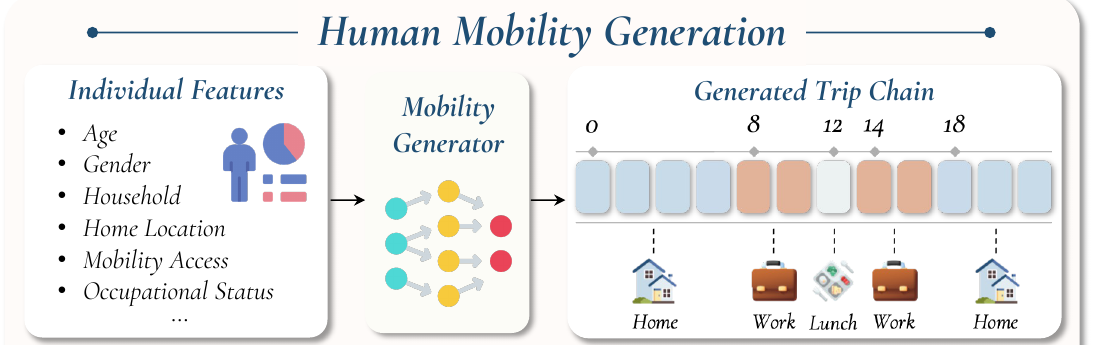
- MobEvolve: An Agentic Self-Evolving Heuristic System for Interpretable Human Mobility GenerationarXiv preprint arXiv:2606.01640, 2026TL;DR: Builds a self-evolving heuristic-agent system that generates interpretable human mobility records with behavioral plausibility and macro-level distribution alignment.
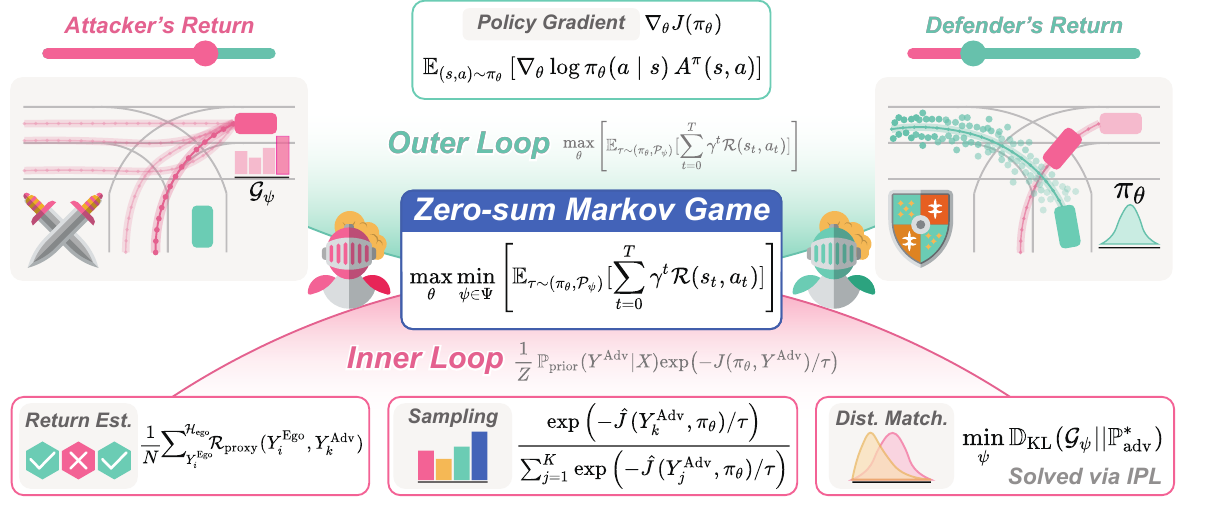
- ADV-0: Closed-Loop Min-Max Adversarial Training for Long-Tail Robustness in Autonomous DrivingarXiv preprint arXiv:2603.15221, 2026TL;DR: Formulates closed-loop adversarial training as a min-max game to improve long-tail robustness against rare but safety-critical autonomous driving scenarios.
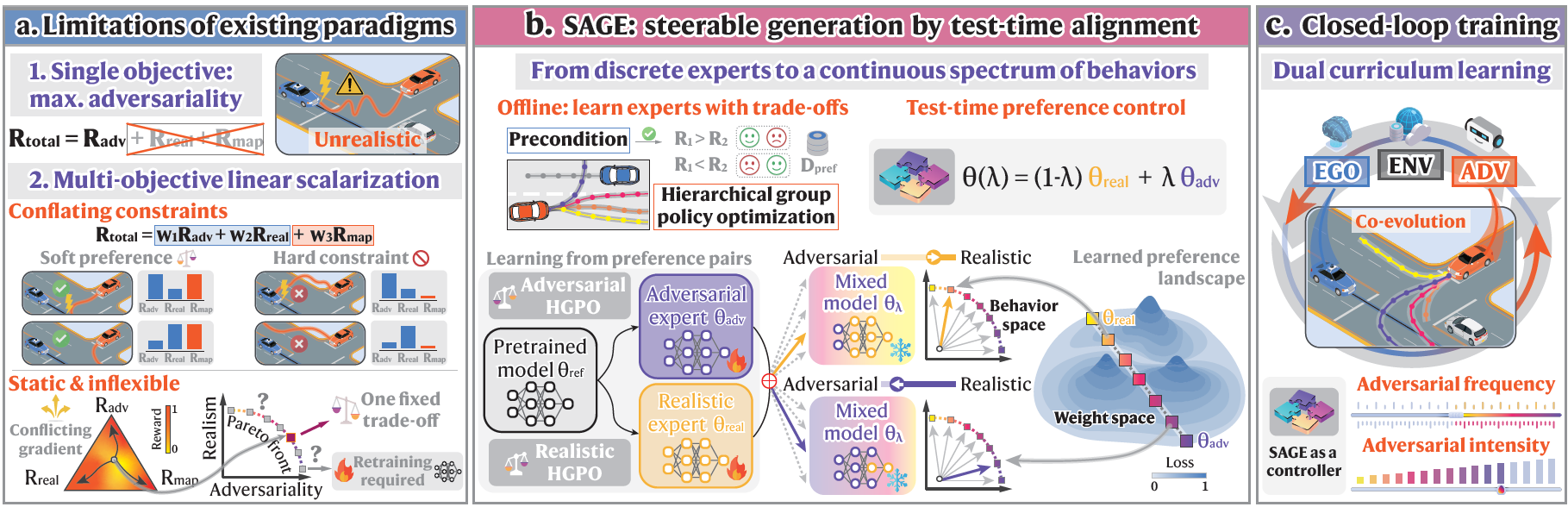
- Steerable Adversarial Scenario Generation through Test-Time Preference AlignmentIn International Conference on Learning Representations, 2026TL;DR: Aligns adversarial scenario generation with test-time preferences, enabling steerable driving tests that remain realistic while exposing targeted failures.
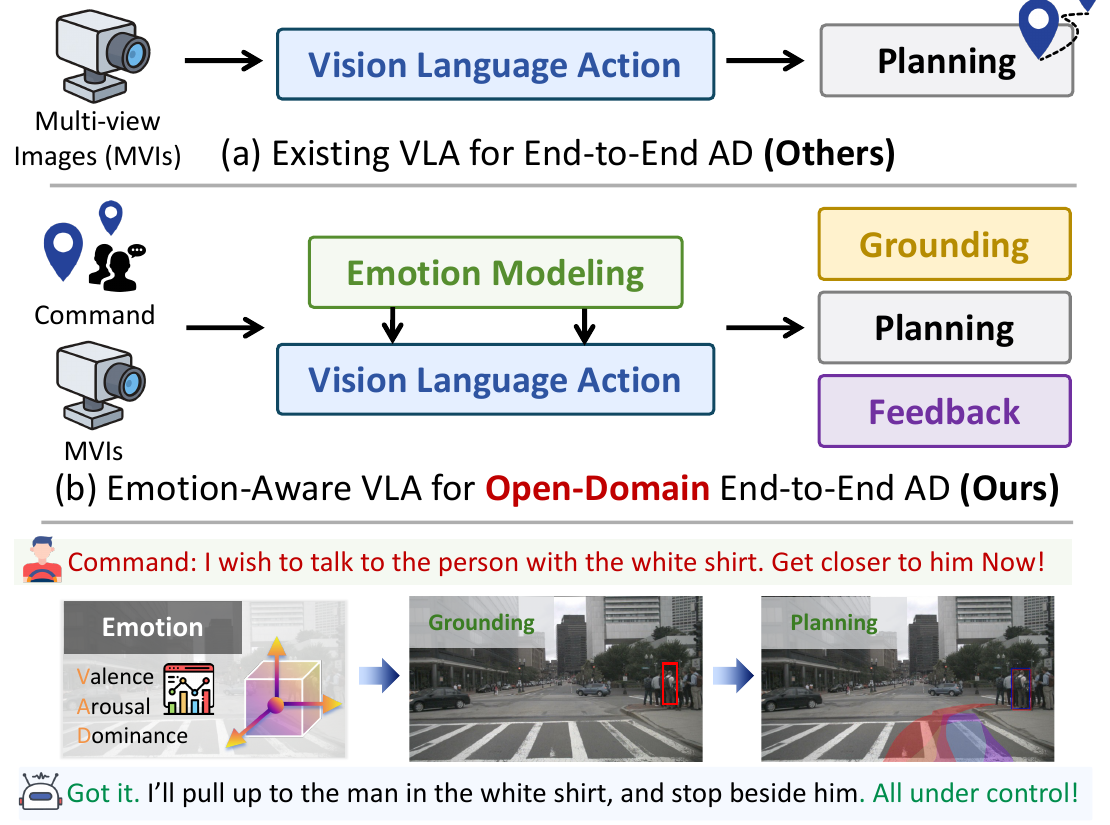
- E3AD: An Emotion-Aware Vision-Language-Action Model for Human-Centric End-to-End Autonomous DrivingIn IEEE/CVF Conference on Computer Vision and Pattern Recognition, 2026TL;DR: Adds emotion-aware vision-language-action reasoning to end-to-end autonomous driving for more human-centric behavior in open traffic scenarios.
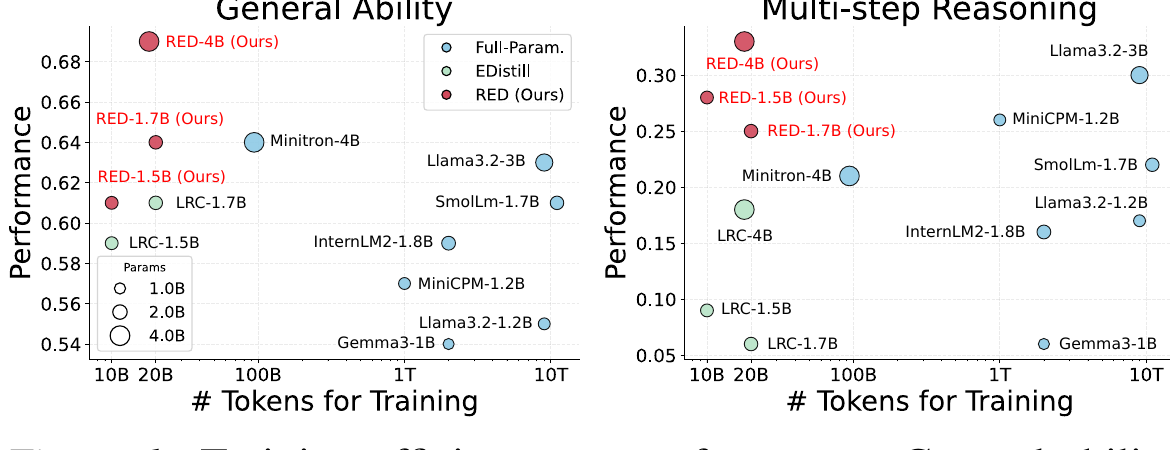
- Reasoning-preserved Efficient Distillation of Large Language Models via Activation-aware InitializationIn International Conference on Machine Learning, 2026TL;DR: Preserves LLM reasoning ability during efficient distillation by initializing compact models with activation-aware knowledge from larger models.
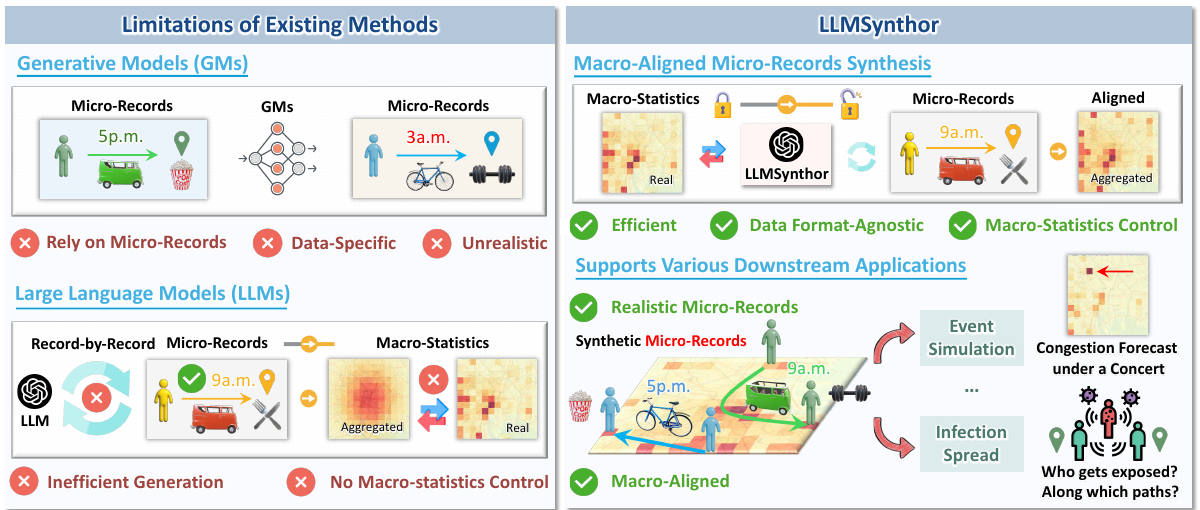
- LLMSynthor: Macro-Aligned Micro-Records Synthesis with Large Language ModelsIn ACM SIGKDD Conference on Knowledge Discovery and Data Mining, 2026TL;DR: Synthesizes micro-level records with LLMs while matching macro-level aggregate controls, improving realistic data generation under distribution constraints.
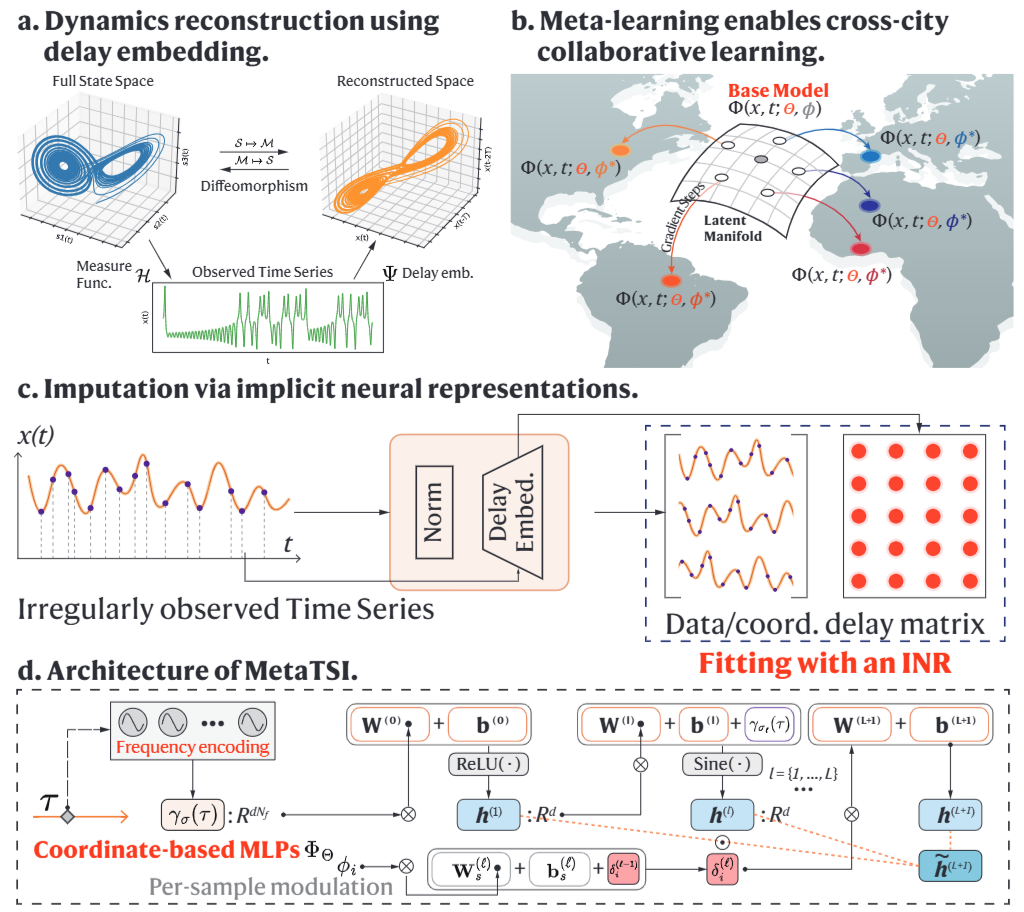
- Collaborative Imputation of Urban Time Series through Cross-City Meta-LearningIEEE Transactions on Knowledge and Data Engineering, 2026TL;DR: Learns cross-city meta-initializations for implicit neural representations, enabling collaborative imputation of urban time series with limited target-city data.
2025
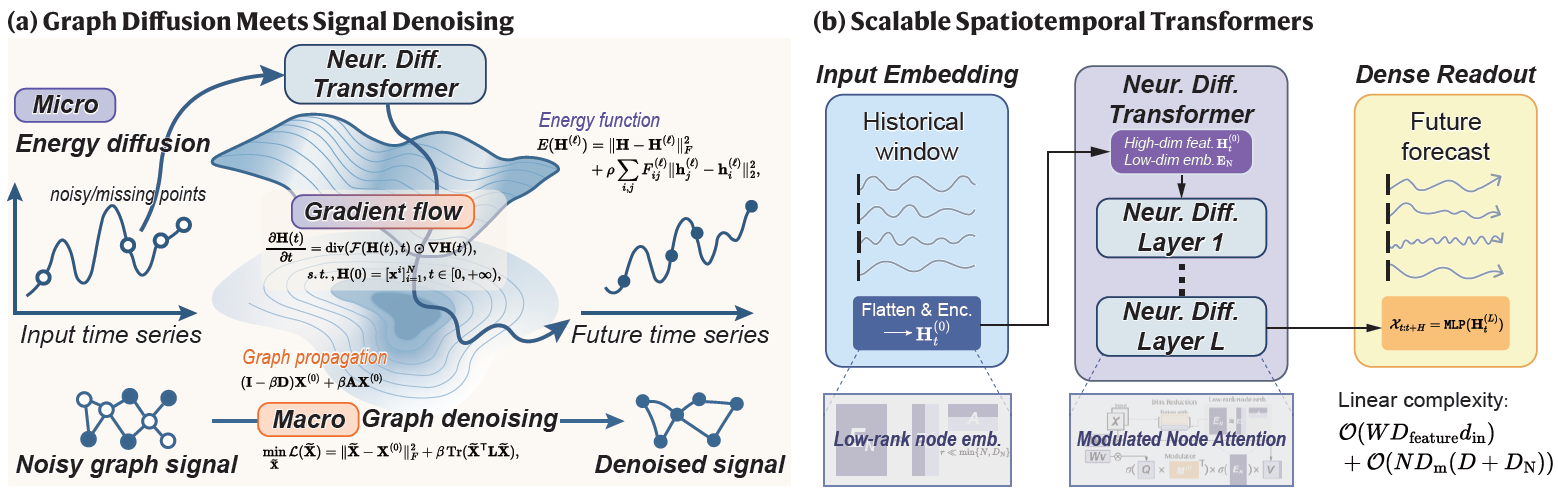
- Predicting Large-scale Urban Network Dynamics with Energy-informed Graph Neural DiffusionIEEE Transactions on Industrial Informatics, 2025TL;DR: Models large-scale urban network dynamics with an energy-informed graph neural diffusion mechanism that is interpretable and scalable for real city systems.
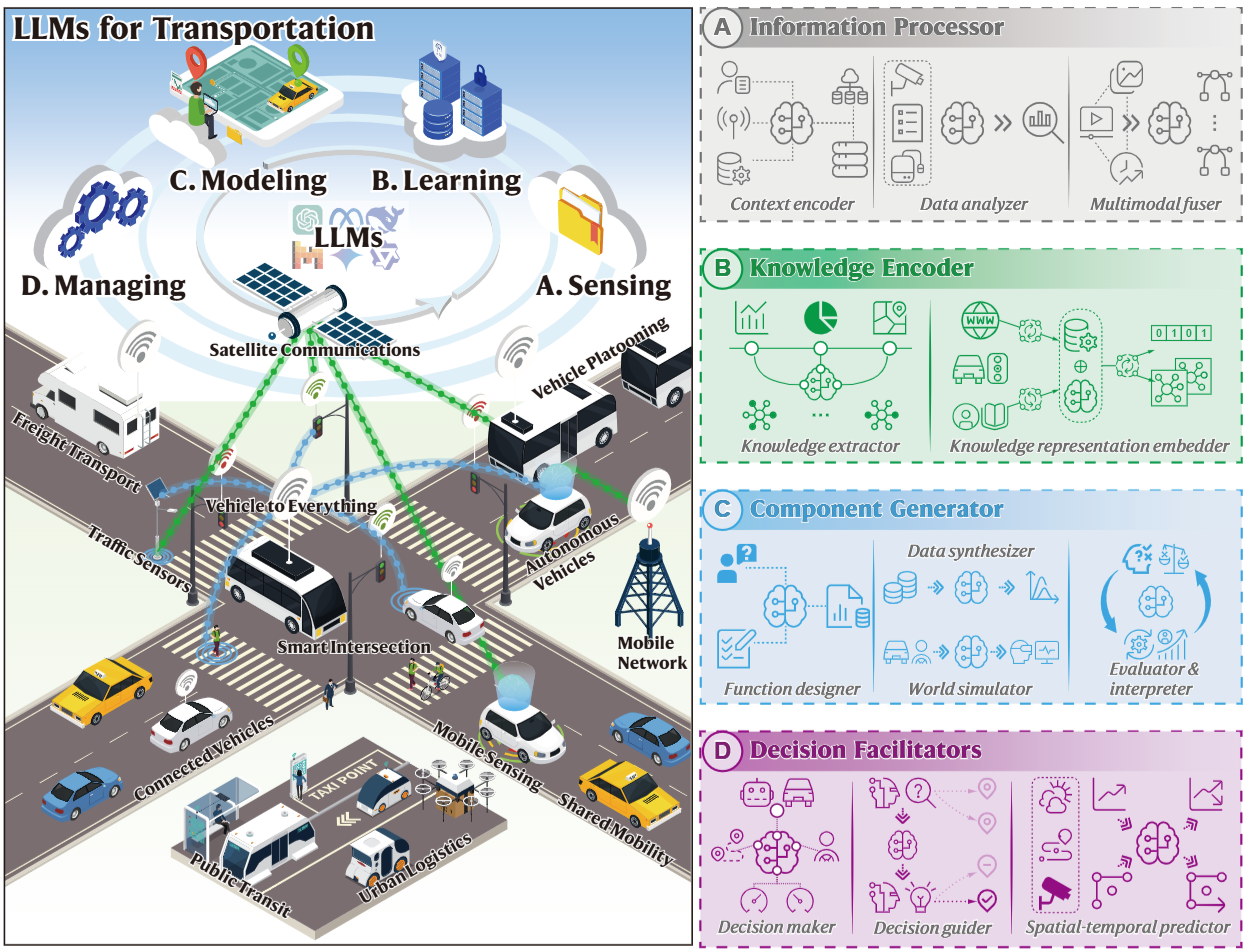
- Exploring the Roles of Large Language Models in Reshaping Transportation Systems: A Survey, Framework, and RoadmapArtificial Intelligence for Transportation, 2025TL;DR: Surveys how LLMs can reshape transportation sensing, modeling, management, and decision support, with a framework and roadmap for the field.
- LLM-attacker: Enhancing Closed-loop Adversarial Scenario Generation for Autonomous Driving with Large Language ModelsIEEE Transactions on Intelligent Transportation Systems, 2025TL;DR: Uses LLMs to enhance closed-loop adversarial scenario generation, improving the discovery of safety-critical failures for connected autonomous vehicle testing.
- Joint Estimation and Prediction of City-wide Delivery Demand: A Large Language Model Empowered Graph-based Learning ApproachTransportation Research Part E: Logistics and Transportation Review, 2025TL;DR: Combines LLM-based location encoding with graph learning to jointly estimate and predict city-wide delivery demand across urban regions.
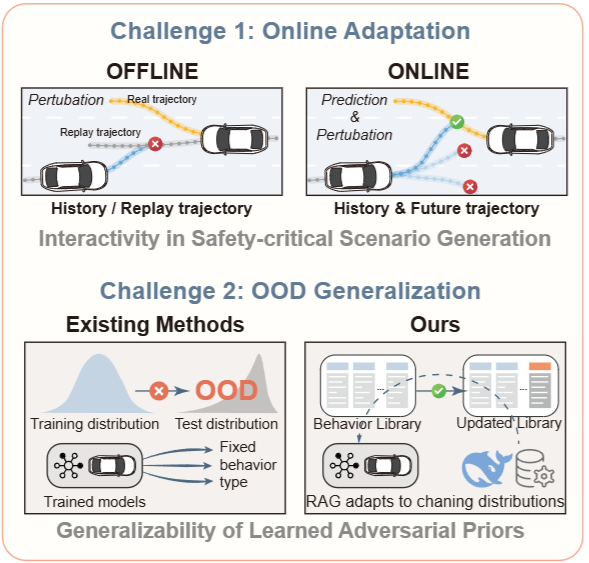
- Seeking to Collide: Online Safety-Critical Scenario Generation for Autonomous Driving with Retrieval Augmented Large Language ModelsIn IEEE International Conference on Intelligent Transportation Systems, 2025TL;DR: Uses retrieval-augmented LLMs for online generation of collision-seeking scenarios that stress-test autonomous driving policies.
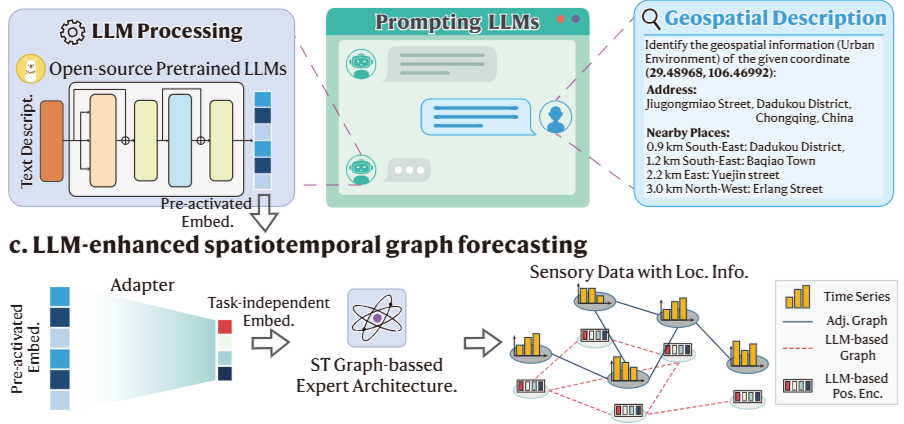
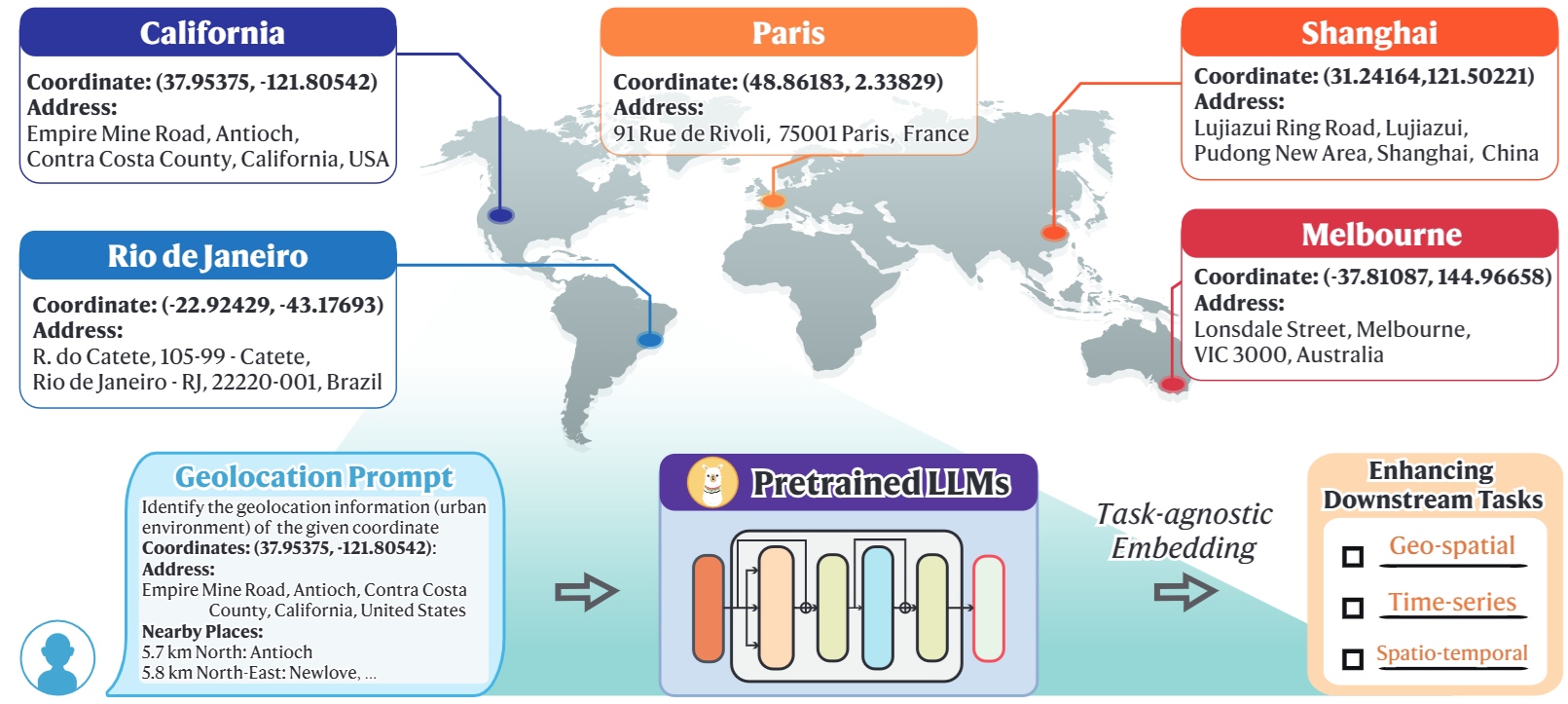
- Geolocation Representation from Large Language Models are Generic Enhancers for Spatio-Temporal LearningIn AAAI Conference on Artificial Intelligence, 2025TL;DR: Extracts training-free geolocation representations from LLMs as generic enhancers for diverse spatiotemporal prediction tasks.
2024
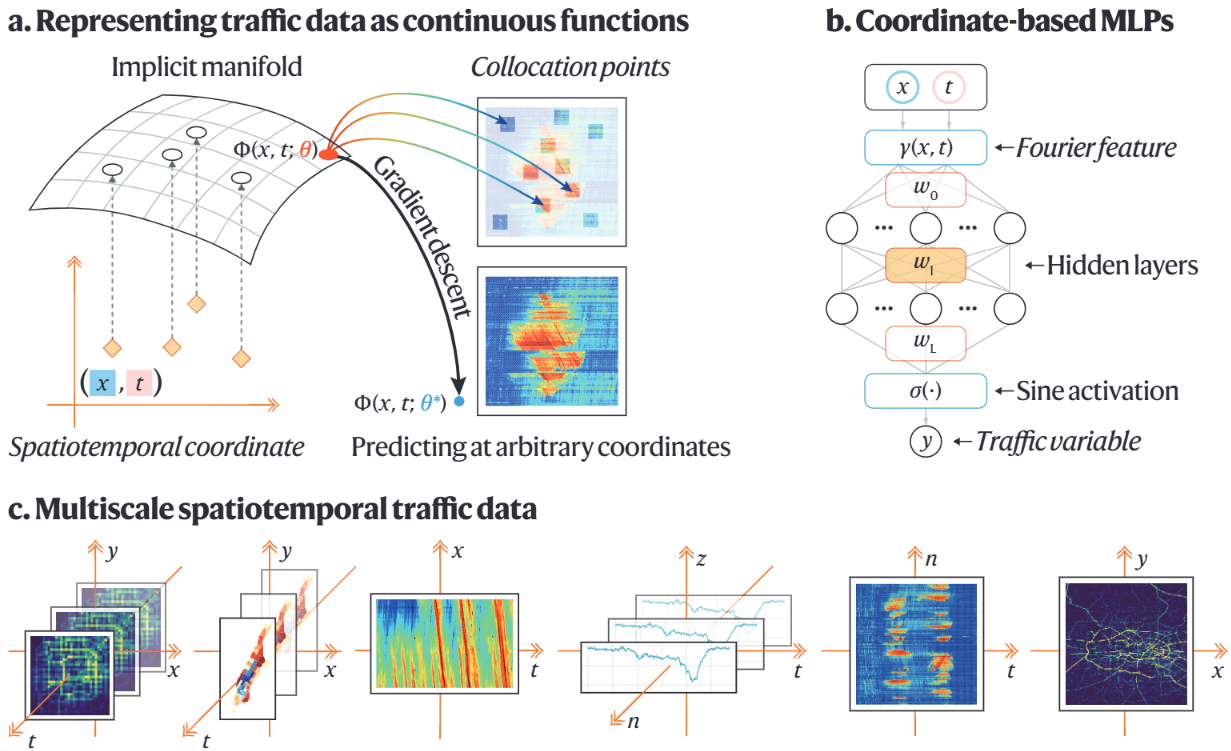
- Spatiotemporal Implicit Neural Representation as a Generalized Traffic Data LearnerTransportation Research Part C: Emerging Technologies, 2024TL;DR: Represents traffic dynamics as continuous implicit neural functions, creating a generalized learner for sparse, irregular, and multi-resolution traffic data.
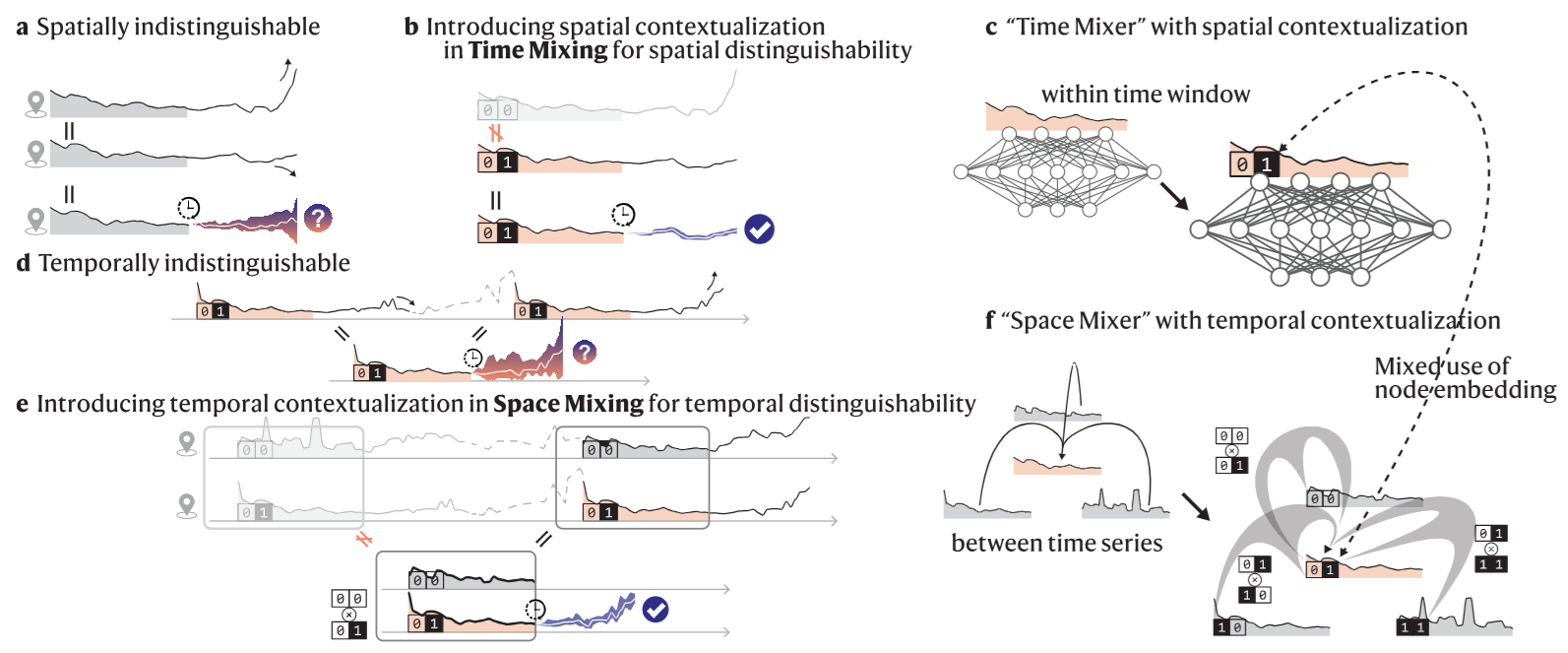
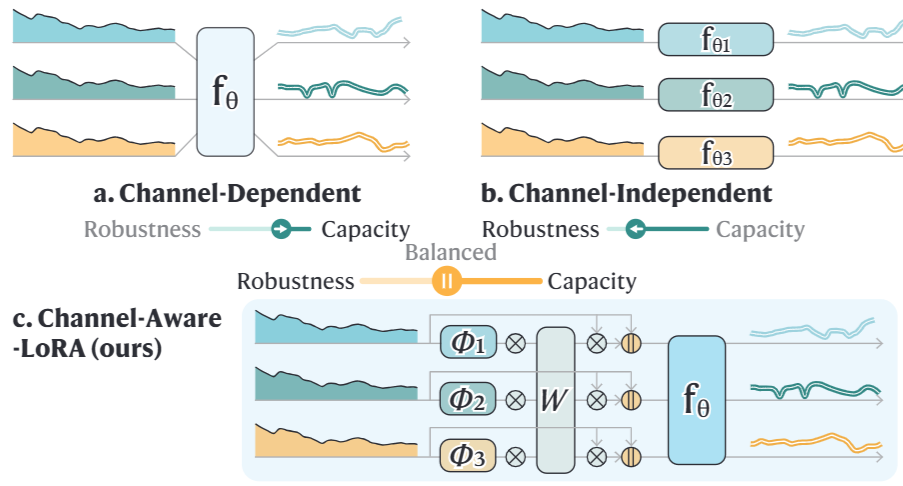
- Channel-Aware Low-Rank Adaptation in Time Series ForecastingIn ACM International Conference on Information and Knowledge Management, 2024TL;DR: Introduces channel-aware low-rank adaptation to balance channel independence and dependence in efficient multivariate time-series forecasting.
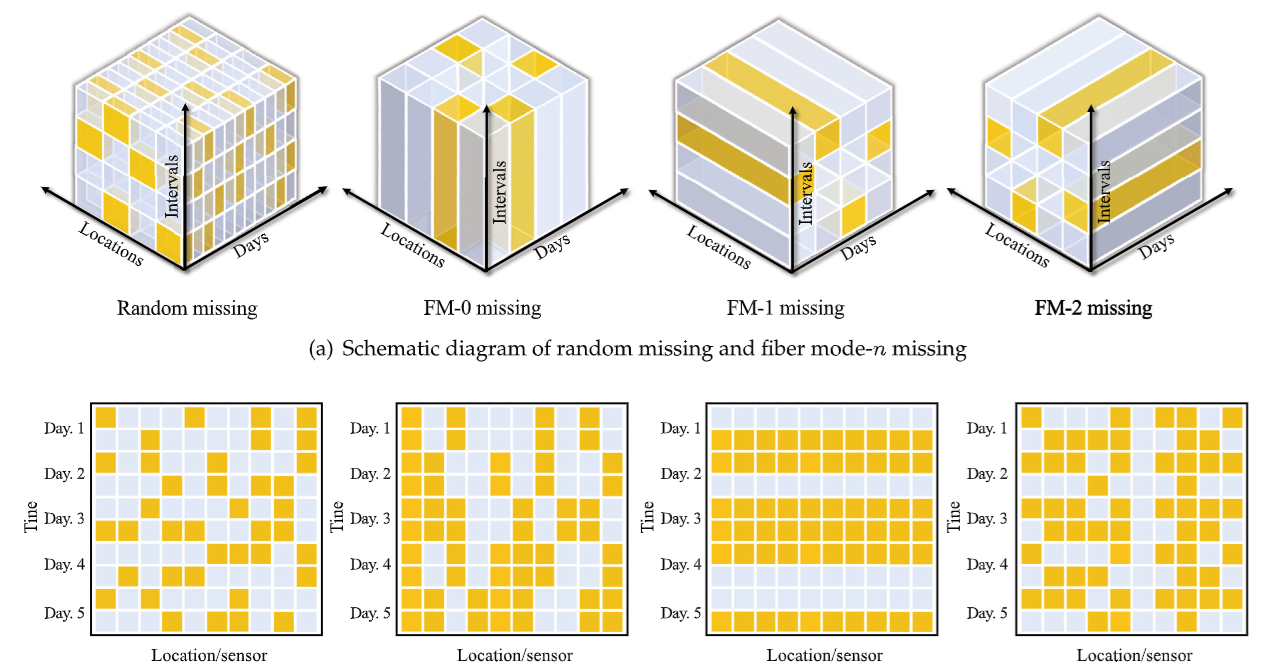
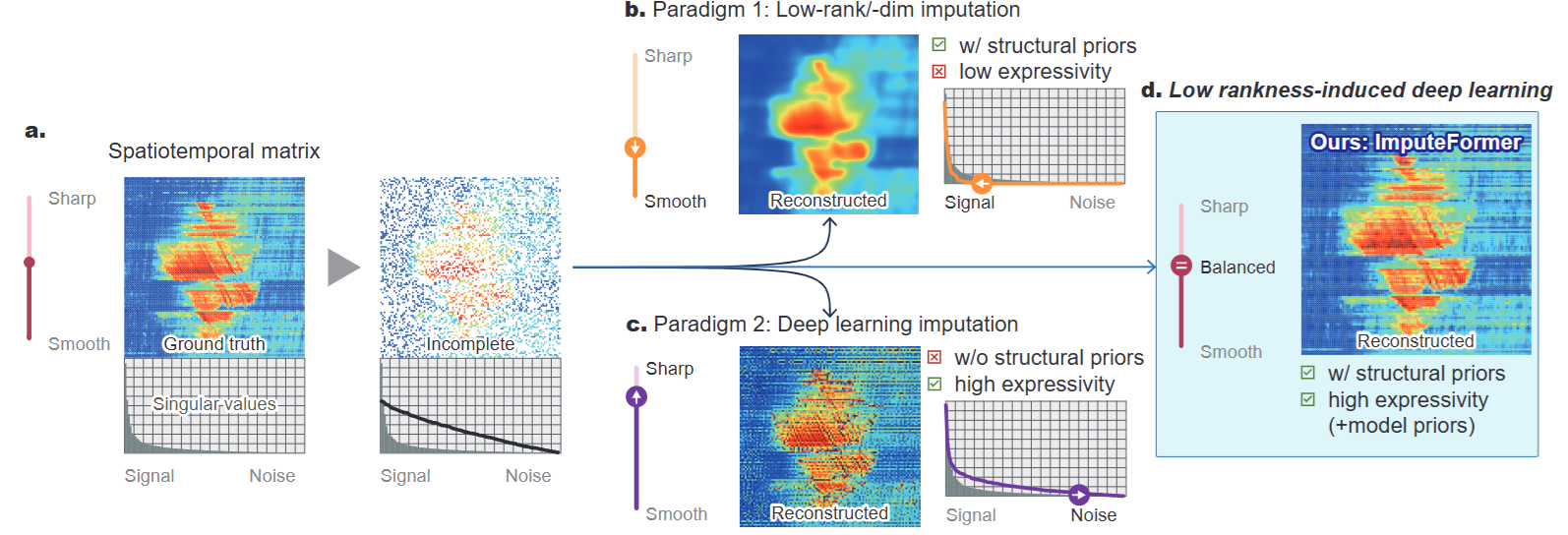
- ImputeFormer: Low Rankness-Induced Transformers for Generalizable Spatiotemporal ImputationIn ACM SIGKDD Conference on Knowledge Discovery and Data Mining, 2024TL;DR: Injects low-rank structure into Transformers for generalizable and efficient spatiotemporal imputation under diverse missing patterns.
2023
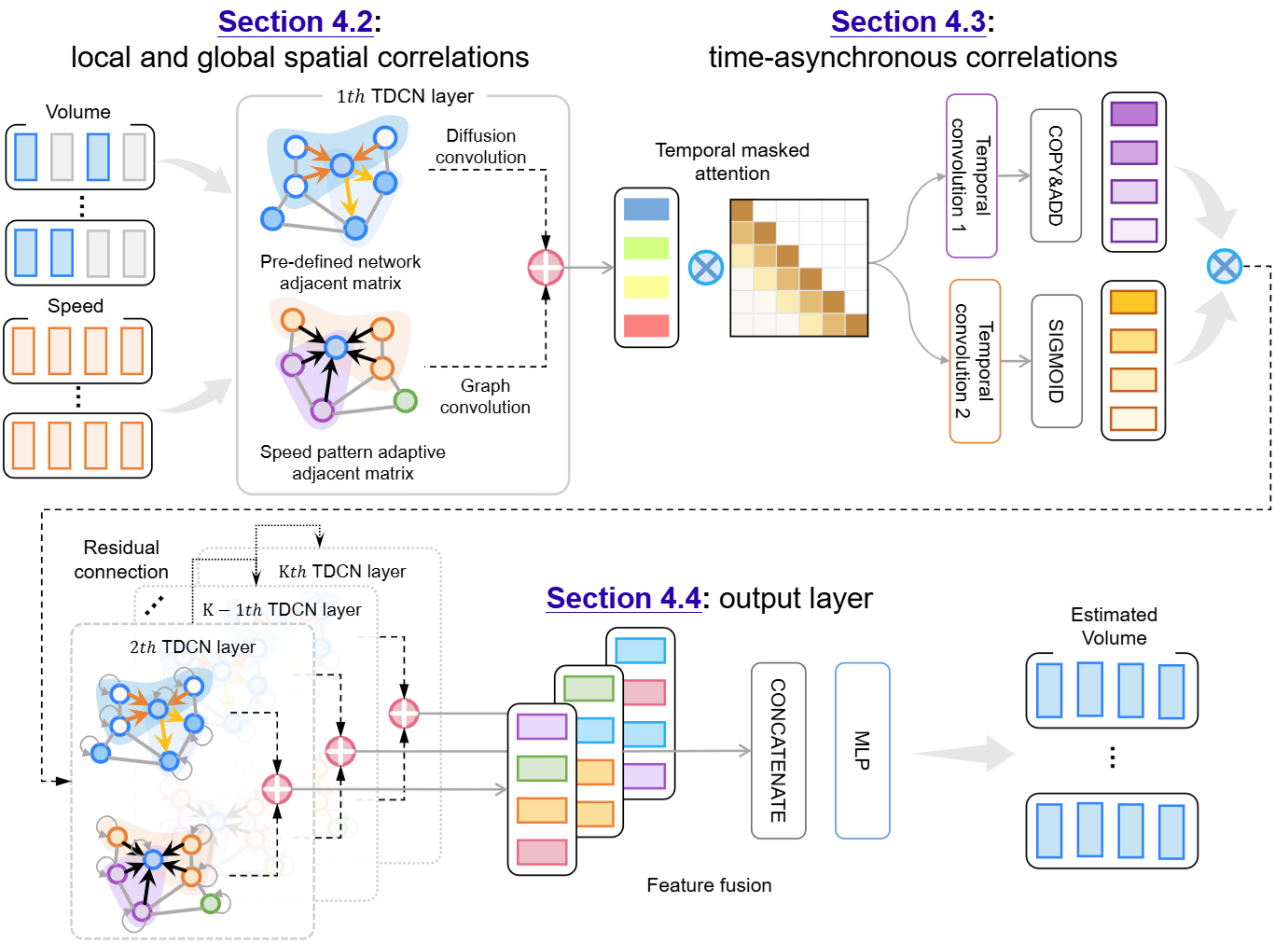
- Towards Better Traffic Volume Estimation: Jointly Addressing the Underdetermination and Nonequilibrium Problems with Correlation-Adaptive GNNsTransportation Research Part C: Emerging Technologies, 2023TL;DR: Addresses underdetermination and nonequilibrium in traffic volume estimation with correlation-adaptive graph neural networks.
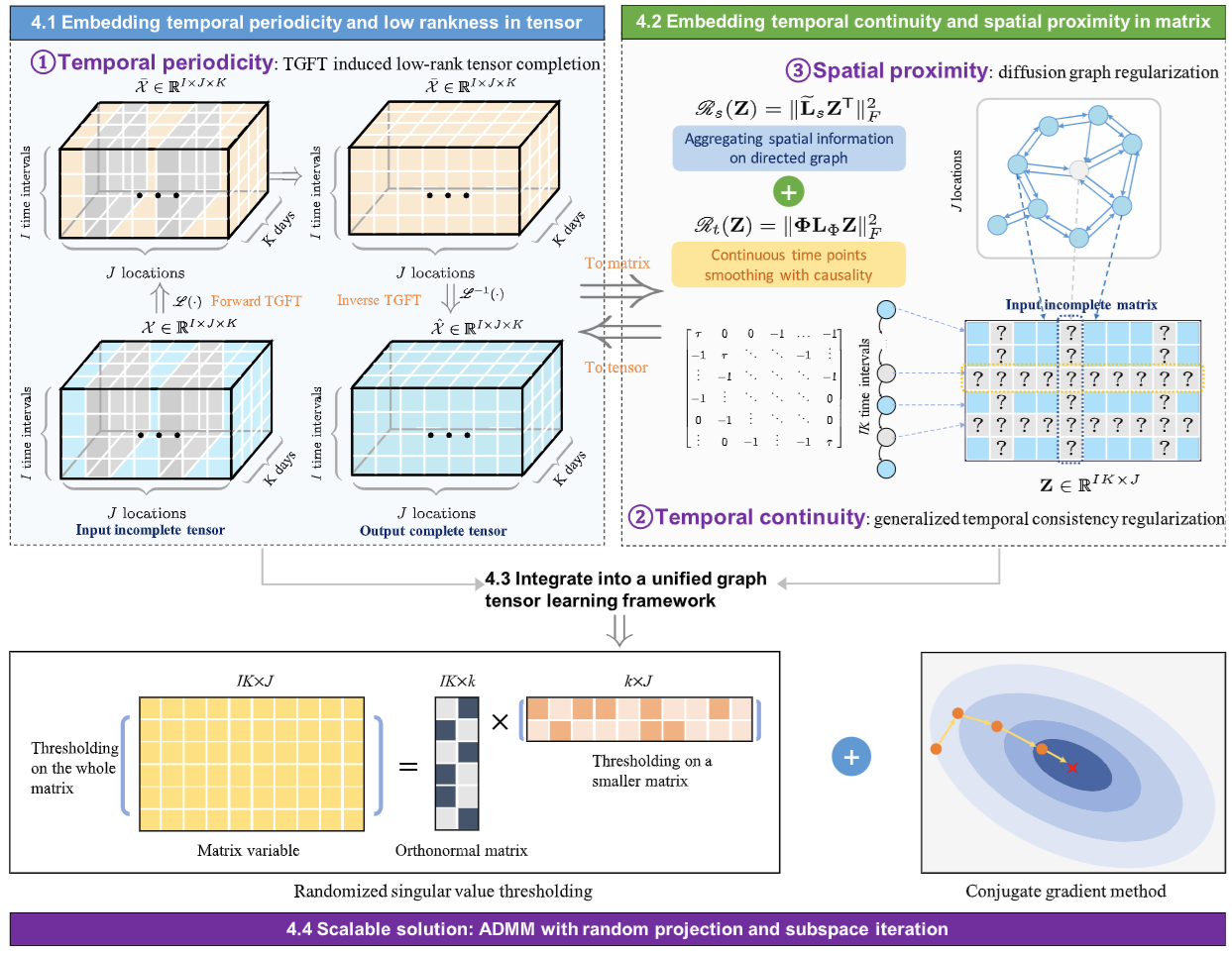
- Correlating Sparse Sensing for Large-Scale Traffic Speed Estimation: A Laplacian-Enhanced Low-Rank Tensor Kriging ApproachTransportation Research Part C: Emerging Technologies, 2023TL;DR: Combines low-rank tensor kriging with Laplacian graph regularization to estimate large-scale traffic speeds from sparse sensors.
2022
- Truncated Tensor Schatten p-Norm Based Approach for Spatiotemporal Traffic Data Imputation with Complicated Missing PatternsTransportation Research Part C: Emerging Technologies, 2022TL;DR: Uses truncated tensor Schatten p-norm regularization with ADMM to impute traffic data under complex missing patterns.