Handcrafted generators stay near known priors.
Handcrafted rules and scalar rewards tend to explore near designer-specified behaviors.
Preprint
Simulator-grounded LLM agents evolve adversarial driving scenario generators while preserving realism through a Pareto archive.
1The Hong Kong Polytechnic University 2Tongji University 3McGill University 4Mila-Quebec AI Institute
Abstract
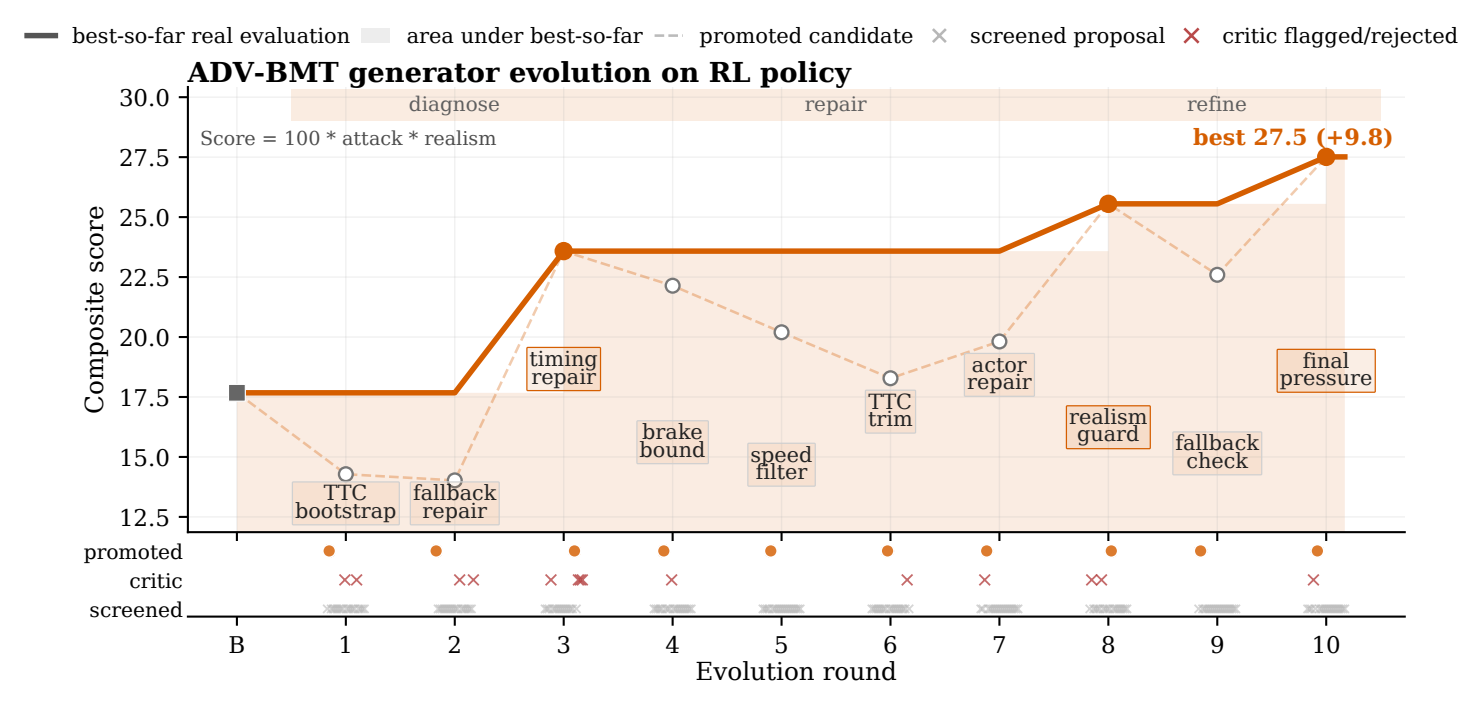
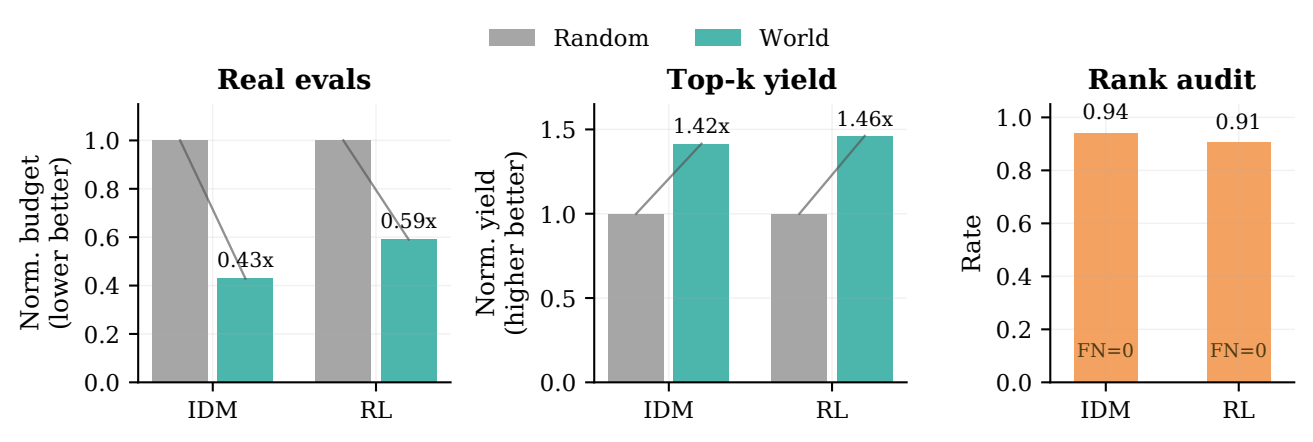
Generating safety-critical scenarios requires exposing failures while keeping scenes physically plausible. EvoDrive uses a simulator-grounded actor-critic architecture where memory-driven agents propose bounded generator edits, critics filter implausible candidates, and a self-evolving world evaluator routes promising proposals under finite simulation budgets. A Pareto archive preserves diverse attack-realism trade-offs and guides future evolution through closed-loop feedback.
Motivation
Handcrafted rules and scalar rewards tend to explore near designer-specified behaviors.
General LLM agents can find high-attack cases, but without simulator grounding they may exploit unrealistic failures.
Useful scenarios should expand the attack-realism frontier instead of collapsing to one fixed compromise.
Method
EvoDrive proposes, validates, evaluates, and archives generator edits. Every accepted candidate is backed by simulator labels, while memory and lineage records guide the next proposal.
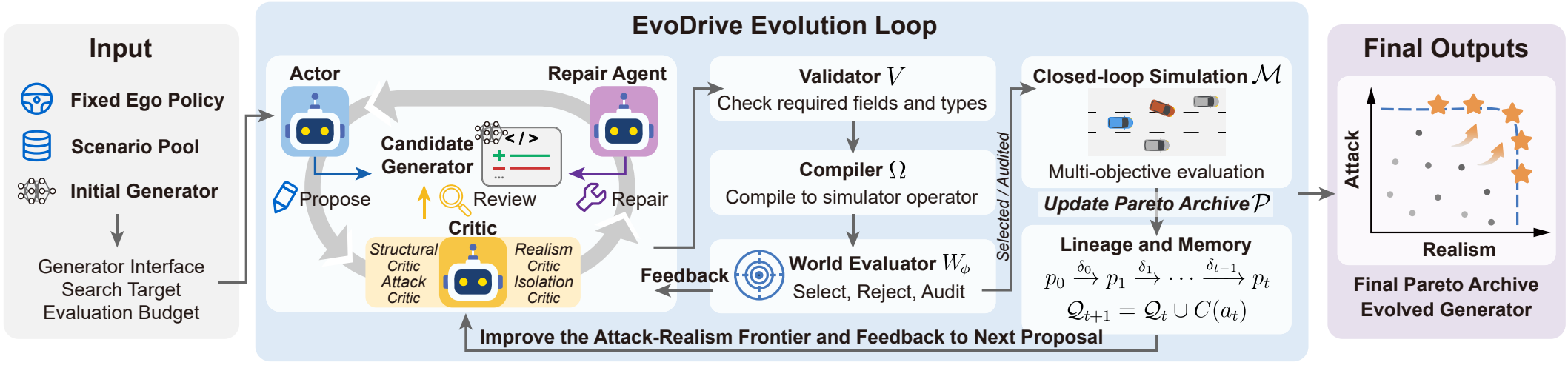
Memory-conditioned actors edit declared generator surfaces rather than arbitrary code.
Specialized critics and deterministic validators filter malformed or implausible candidates before rollout.
Simulator-labeled outcomes update a Pareto frontier over attack and realism.
Supplementary Video
Results
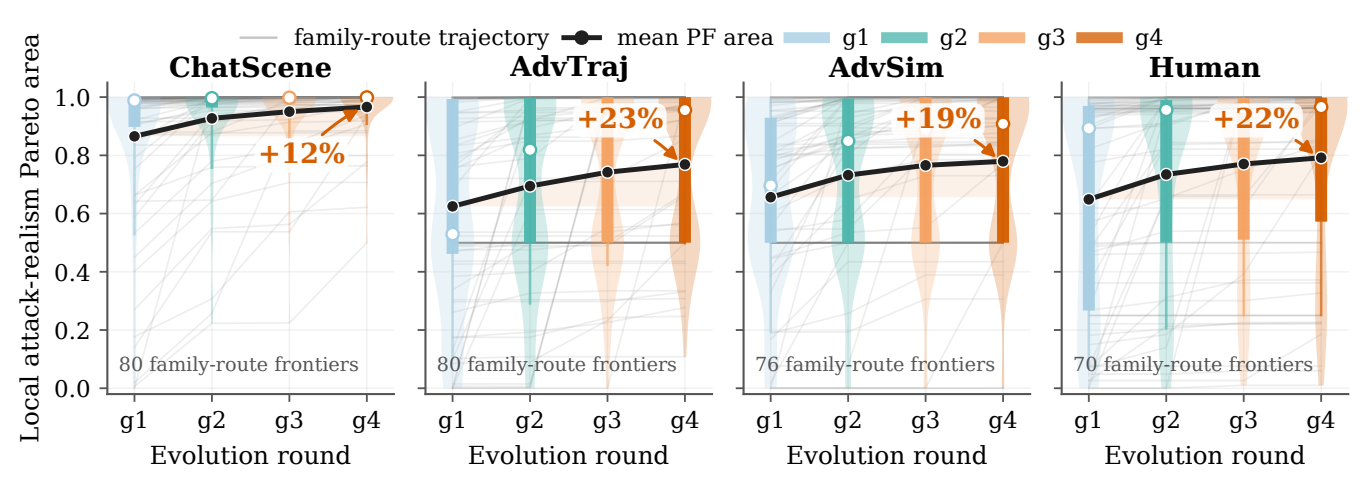
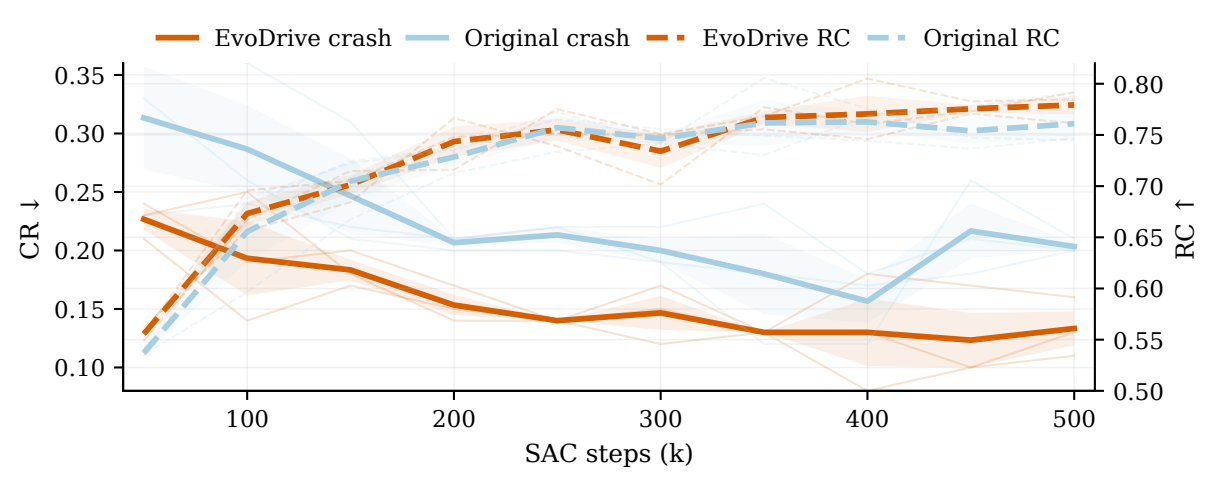
EvoDrive improves Pareto area for every MetaDrive generator family and produces large attack-realism gains on CARLA SafeBench.
Mechanisms
Scenario Examples
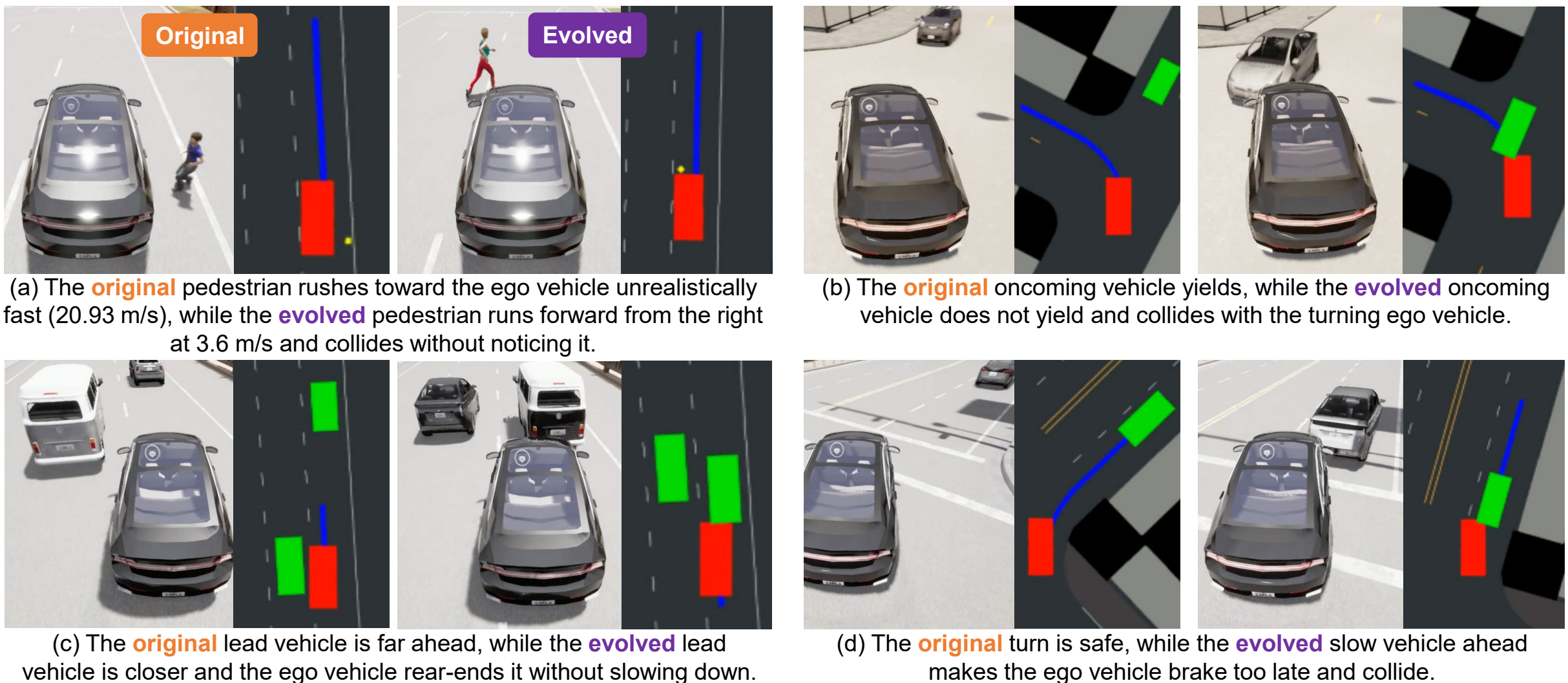
Qualitative examples show original and evolved ChatScene scenarios in CARLA, including RGB and bird's-eye-view renderings.
Citation
@misc{nie2026evodrive,
  title         = {EvoDrive: Pareto Evolution for Safety-Critical Autonomous Driving via Self-Improving LLM Agents},
  author        = {Tong Nie and Yuewen Mei and Yihong Tang and Junlin He and Jie Deng and Jian Sun and Wei Ma},
  year          = {2026},
  eprint        = {2606.03678},
  archivePrefix = {arXiv},
  primaryClass  = {cs.AI},
  doi           = {10.48550/arXiv.2606.03678},
  url           = {https://arxiv.org/abs/2606.03678}
}